
DefenseTech: Overview of MilTech industry in IT

Introduction to MilTech / DefenseTech

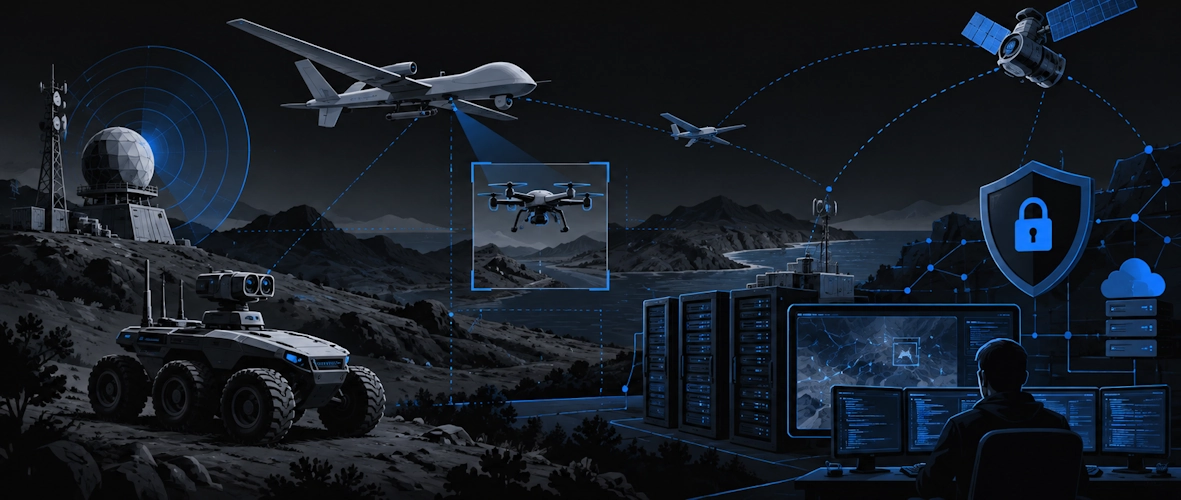
MilTech, or Military Technology, covers technologies developed for military use. DefenseTech is a broader term that includes software, AI, robotics, communications, cybersecurity, manufacturing, and other technologies used by defense organizations.
For engineers, the industry became especially interesting after 2022. Russia's full-scale invasion of Ukraine demonstrated how drones, electronic warfare, satellite data, AI, command-and-control software, and rapid development cycles change modern warfare.
NATO describes the same shift. Innovation cycles that previously took five or six years sometimes take five or six months in Ukraine. Battlefield pressure creates a constant loop of technology, countermeasures, and new technology. NATO's own Rapid Adoption Action Plan now targets finding, testing, and adopting a new technological product within a maximum of 24 months. A NATO official said in February 2026 that the target is realistic and in some cases might already be too slow.
Modern MilTech therefore looks less like traditional military hardware development and more like a mix of robotics, distributed systems, embedded software, AI, edge computing, cybersecurity, and large-scale data platforms.
MilTech, DefenseTech and Dual-Use
- MilTech usually refers to technologies developed specifically for military use.
- DefenseTech covers a wider ecosystem, including military software platforms, AI companies, autonomous systems, cybersecurity, communications, satellites, manufacturing, and supporting infrastructure.
Dual-use technology has both civilian and military applications. Common examples include:
- drones
- satellite imagery
- computer vision
- robotics
- cybersecurity
- navigation systems
- AI
- advanced communications
- cloud and edge computing
Dual-use is not only a technical category. It is a business strategy. Most European and US defense startups build a dual-use story deliberately, because it widens the funding pool, avoids some export restrictions, and keeps a civilian revenue line if defense budgets shift.
A Short History of MilTech
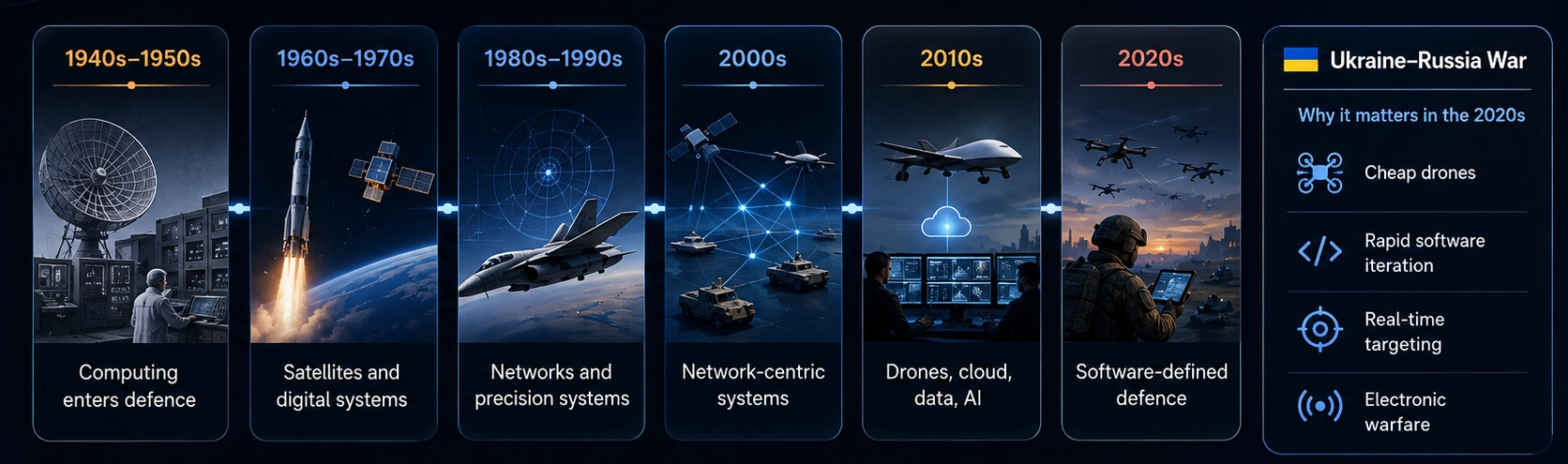
Four rough eras help explain why the industry looks the way it does today.
- Cold War platform era. Capability lived in hardware. Programs ran for decades. A small number of primes built vertically integrated systems with custom everything.
- Precision and networking era, 1990s to 2010s. GPS, precision munitions, and datalinks made information the differentiator. Software started to matter, but it was still delivered as part of a platform contract.
- COTS and drone era, 2022 onward. Ukraine showed that commercial components, consumer radios, 3D printing, and open-source flight stacks can produce militarily relevant systems in weeks. Volume and iteration speed started to beat unit sophistication in several categories.
- Software-defined era, 2024 to now. The same airframe, vehicle, or sensor gains new capability through updated autonomy and mission software. Contracts increasingly reflect this. Germany's February 2026 contract for Helsing's HX-2 reportedly included an innovation clause requiring the vendor to keep delivering upgraded versions, a procurement structure borrowed from software rather than munitions.
MilTech / DefenseTech Glossary of Terms
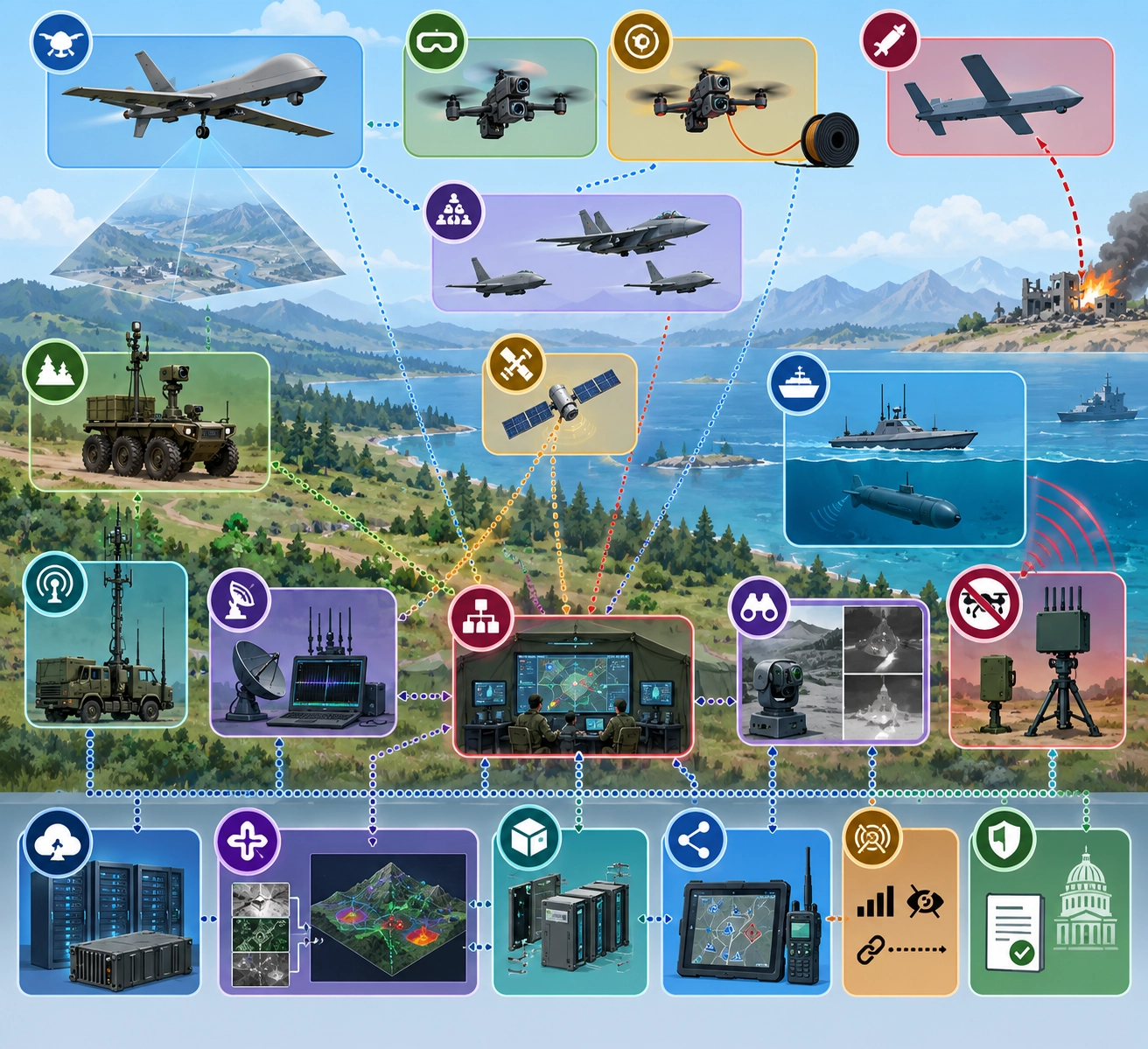
- UAV / UAS: Uncrewed aerial vehicle or system. The broader UAS term includes the aircraft, software, communications, sensors, and ground-control infrastructure.
- FPV: First-person view. A small drone flown from a live camera feed, usually cheap and expendable.
- Fiber-optic FPV: An FPV drone controlled through a trailing optical fiber instead of a radio link.
- Loitering munition: A one-way attack drone that searches for a target before striking.
- UGV: Uncrewed ground vehicle used for logistics, reconnaissance, evacuation, and other tasks.
- USV / UUV: Uncrewed surface and underwater vehicles used in maritime environments.
- C-UAS: Counter-UAS systems designed to detect, track, and counter drones.
- EW: Electronic Warfare. Technologies related to the electromagnetic spectrum, including detection, protection, interference, and communication.
- SIGINT: Signals intelligence. Collection and analysis of intercepted electronic emissions.
- C2: Command and Control. Systems used to coordinate information, assets, and operations.
- ISR: Intelligence, Surveillance, and Reconnaissance.
- GNSS: Global Navigation Satellite System. GPS is one example.
- DDIL: Disconnected, Degraded, Intermittent, or Low-bandwidth. The standard term for the network conditions military software must assume.
- Sensor Fusion: Combining information from cameras, radar, thermal sensors, radio sensors, and other sources.
- Tactical Edge: Computing infrastructure located close to sensors, vehicles, drones, or operators instead of a remote data center.
- MOSA: Modular Open Systems Approach. A US requirement to build systems from modular components with published interfaces.
- CoT / TAK: Cursor on Target, a lightweight XML message format for positions and events, and the Team Awareness Kit family of situational-awareness clients built around it.
- CCA: Collaborative Combat Aircraft. Uncrewed aircraft designed to fly alongside crewed fighters.
- ATO: Authority to Operate. The security accreditation a system needs before it can run on a government network.
Key Technologies and Tools in MilTech

Drones and Autonomous Systems
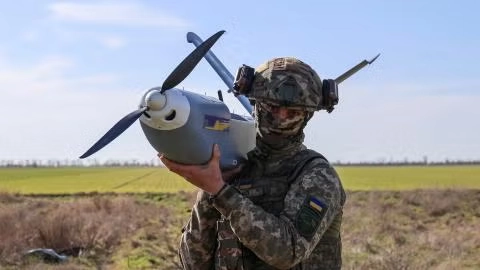
Drones became one of the clearest examples of software changing warfare.
Modern UAV software covers much more than remote control. Common areas include:
- flight control
- mission planning
- computer vision
- navigation
- sensor fusion
- autonomous behavior
- mesh communication
- coordination between multiple platforms
Ukraine provides the largest current real-world testing environment for many of these technologies. Brave1 lists more than 500 UAV manufacturers and more than 200 AI product manufacturers inside its Ukrainian defense innovation cluster, alongside naval drone, missile, and ammunition producers. Market trackers estimate Ukraine is on track to produce roughly 4.5 million FPV drones in 2026, with an installed capacity of 8 to 10 million units per year, built by around 500 manufacturers, up from about seven before 2022.
Brave1 also runs a Test in Ukraine program, launched in July 2025, that lets foreign manufacturers test UAVs, AI systems, interceptors, and communication equipment against real operator feedback and on training grounds that replicate combat conditions.
NATO follows the same direction. DIANA's 2026 Challenge Program includes an Autonomy and Unmanned Systems track that explicitly asks for algorithms for autonomous navigation, adaptation, and decision-making of uncrewed swarms in contested, GPS-denied, dynamic, and extreme environments.
Companies such as Shield AI take the idea further. Its Hivemind platform separates autonomy software from a specific aircraft. The same autonomy stack targets aircraft, maritime systems, logistics platforms, and other robotic systems.
Fiber-Optic Drones
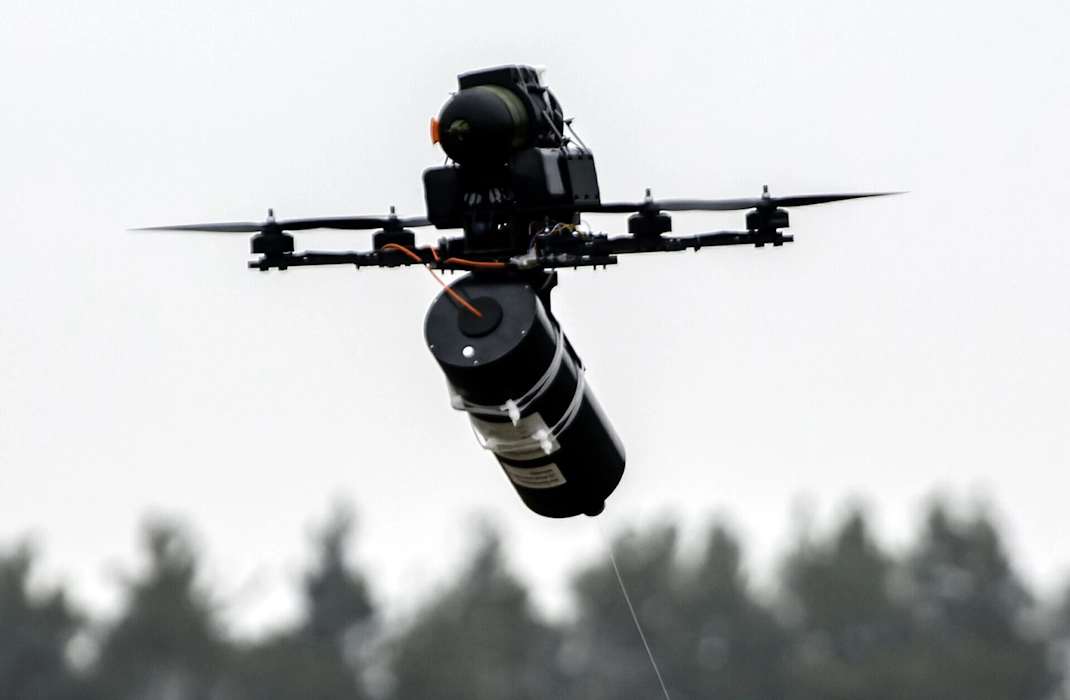
This is the single most important tactical change of 2025 and 2026, and it directly counters electronic warfare.
A fiber-optic FPV drone carries a spool of hair-thin optical fiber that unwinds as it flies. Control signals and video travel through the fiber as light, not radio waves. No RF emissions mean nothing for an EW system to detect, jam, or spoof. The drone flies through dense jamming as if it were not there.
The economics are what made it spread. A spool reportedly adds under 100 dollars to a drone that already costs a few hundred. The trade-off is range, currently around 10 to 20 kilometers, limited by how much fiber the airframe can carry. For close-range FPV attacks that dominate the front line, that is enough.
Scale figures show the shift. By September 2025, defense-industry analysts estimated that Russia alone was producing 50,000 or more fiber-optic FPV drones per month. Ukraine's former defense minister said 352,000 fiber-optic FPV drones had been delivered to the armed forces since July 2025, excluding volunteer supply and the e-points incentive scheme.
There is no clean countermeasure. Countering fiber-optic drones was the central theme of NATO's 2025 Innovation Challenge. Responses range from physical barriers and road netting to radar tripwires, acoustic sensors, and experimental AI-assisted detection.
For engineers, the consequences are concrete:
- The link problem moves from RF resilience to a physical medium with different latency, bandwidth, and failure characteristics. A cut is a hard disconnect, not a degraded link.
- Detection shifts from RF sensing to acoustics and computer vision. That makes C-UAS a sensor-fusion problem rather than a spectrum problem.
- Autonomy matters less for the strike drone and more for the interceptor, because the target no longer emits anything to home in on.
AI and Computer Vision
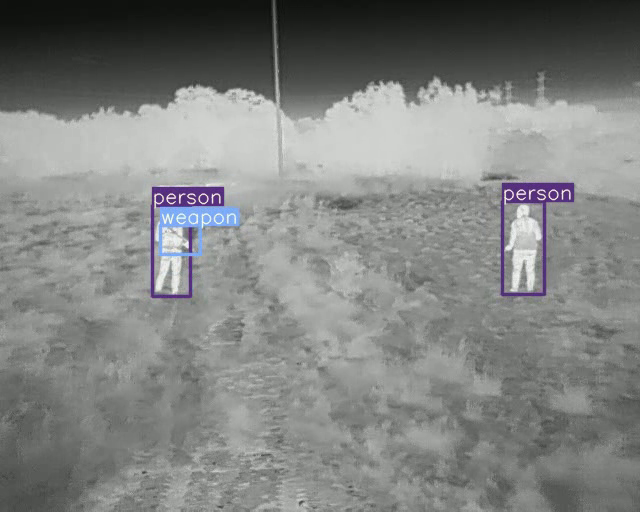
Modern military systems produce huge volumes of video, imagery, radar, radio, and telemetry data.
AI and computer vision help process this information through:
- object detection
- image classification
- navigation
- target re-identification
- sensor fusion
- anomaly detection
- predictive maintenance
- decision support
The engineering challenge differs from a typical cloud ML project. Models often run on small edge computers with limited GPU, memory, power, and network access.
Helsing's HX-2 is one example, and it is also a useful lesson in reading vendor claims. Helsing says the platform uses onboard AI, keeps operating in GNSS-denied environments, and can assemble into operator-supervised swarms through its Altra software. In January 2026, Bloomberg reported that a German Defense Ministry presentation and people familiar with Ukrainian trials described takeoff issues, missing autonomous features, and vulnerability to Russian electronic warfare. Helsing rejected that account, said HX-2 was cleared for frontline use and listed in Ukraine's central ordering system, and said it was delivering several hundred drones per month. A separate WELT investigation cited a Ukrainian document reporting hits in 5 of 14 documented Donbas engagements, while Helsing provided test data from Germany, the UK, and Kenya showing near-100 percent hit rates.
The disagreement matters more than the specific numbers. Benchmark performance, range-test performance, and frontline performance are three different things in this industry, and only the third one counts.
Practical pressure is pushing toward smaller models, local inference, hardware acceleration, model compression, and offline processing.
Electronic Warfare and GNSS-Denied Navigation
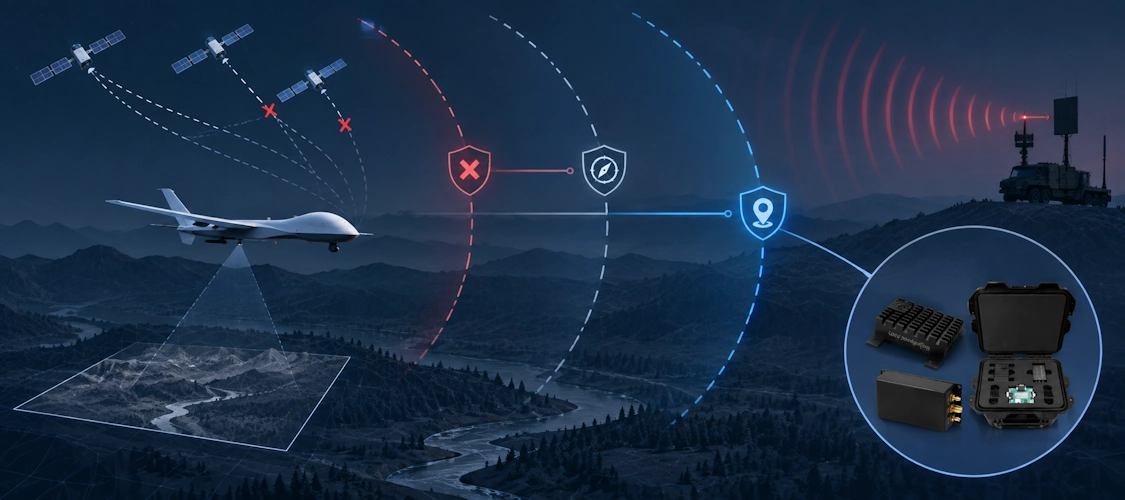
Electronic warfare has become one of the defining technical constraints of modern MilTech.
A drone that depends completely on GPS and a stable radio link has obvious problems when both disappear. Russian EW systems along the front were not improvised. They were purpose-built and layered to create overlapping zones of electromagnetic denial.
Modern systems therefore combine several approaches:
- inertial navigation
- visual navigation and terrain matching
- sensor fusion
- alternative positioning systems
- adaptive and frequency-agile communications
- local autonomous behavior
- removing the radio link entirely, as with fiber optics
NATO DIANA runs a dedicated Contested Electromagnetic Environments challenge focused on sensing, navigation, datalink, and spectrum-management solutions that stay robust under interference and congestion. Its 2026 call asks for weak-signal detection, dynamic spectrum allocation, and software-defined radio systems that can be rapidly adapted.
Electronic warfare creates a constant engineering race between communication, navigation, jamming, detection, and autonomy. The race does not converge. Each solution creates the next problem.
Edge Computing
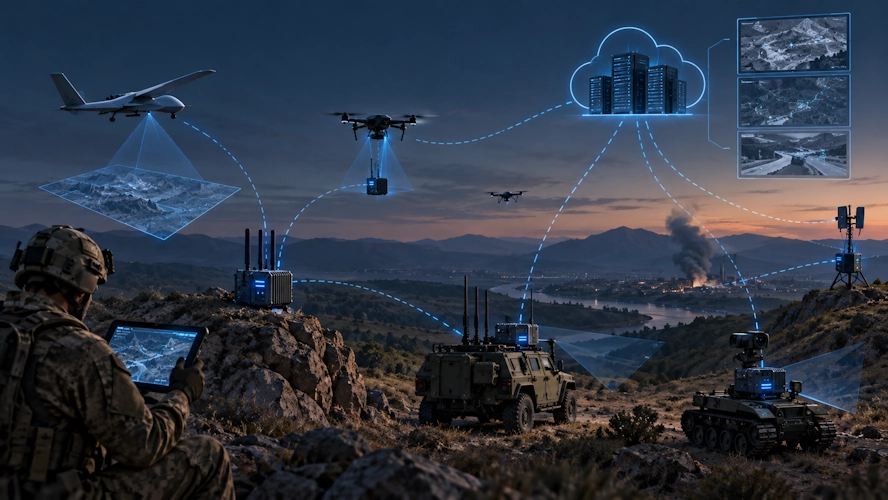
Edge computing is one of the biggest architectural differences between normal SaaS development and MilTech.
A cloud application usually assumes network access. A military platform starts from the opposite assumption. The standard acronym is DDIL: disconnected, degraded, intermittent, or low-bandwidth.
Important workloads therefore run locally:
- AI inference
- computer vision
- sensor processing
- navigation
- local state management
- mission logic
Anduril describes this approach as a local-first architecture. Lattice applications are designed around intermittent networks and limited bandwidth rather than permanent connectivity.
For a distributed-systems engineer, the problems look familiar: network partitions, stale data, synchronization, message prioritization, duplicated events, local state, and eventual consistency. The operating environment makes those problems much less theoretical. A partition is not an incident to page someone about. It is Tuesday.
Command and Control and Battlefield Data
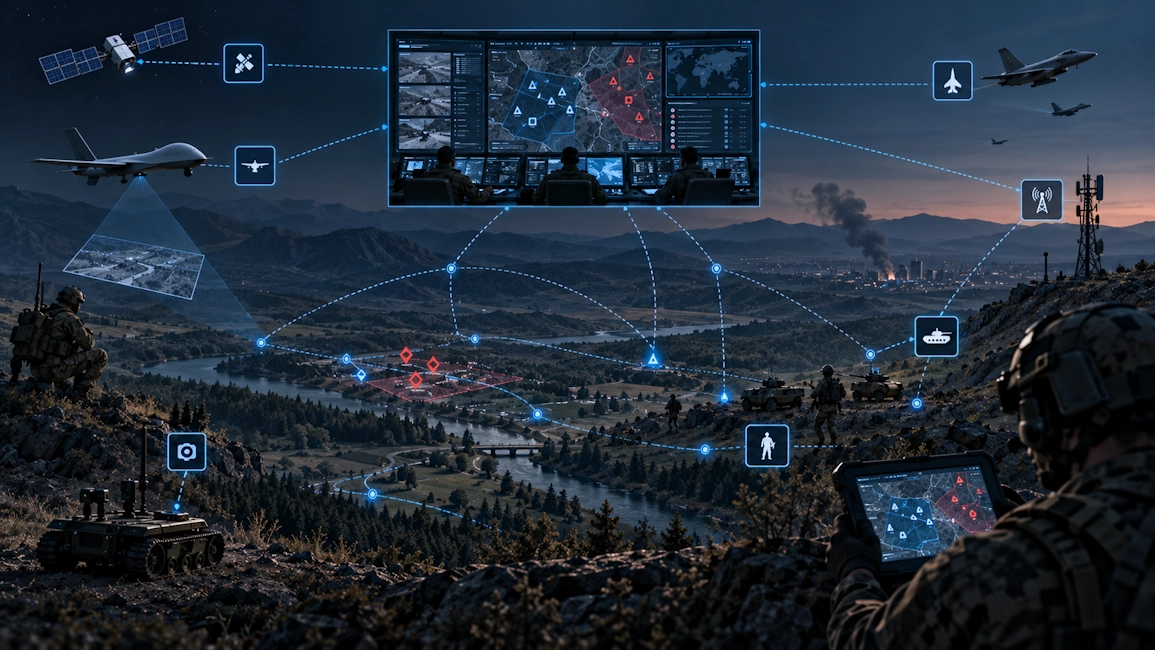
Thousands of drones and sensors create another problem: someone needs to turn all that data into decisions.
Modern C2 platforms combine:
- real-time data ingestion
- geospatial data
- sensor integration
- stream processing
- analytics
- identity and access management
- mission planning
- AI-assisted decision support
Ukraine's DELTA ecosystem is one of the most interesting current examples. It fuses data from drones, satellites, sensors, and human intelligence into a shared picture, and it also acts as the system of record for mission reporting. Ukraine's Ministry of Defence publishes monthly mission statistics drawn from DELTA, which is unusual transparency for a battlefield management system.
DELTA also serves as the authorization layer for Ukraine's incentive economy. The Army of Drones Bonus program integrates DELTA, the DOT-Chain Defense marketplace, and Brave1 Market. Units earn points for confirmed strikes and exchange them for equipment through Brave1 Market after DELTA authorization. That is an identity, entitlement, and marketplace design problem running under adversarial conditions.
NATO is moving toward similar data-driven systems. The NATO Communications and Information Agency finalized the acquisition of Palantir's Maven Smart System NATO on 25 March 2025 for use within Allied Command Operations. NATO described it as the fastest acquisition in the alliance's history, roughly six months from concept to contract. On the US side, the Joint Staff, combatant commands, and elements across the department and intelligence community use Maven Smart System.
Counter-Drone Systems and Cost Inversion
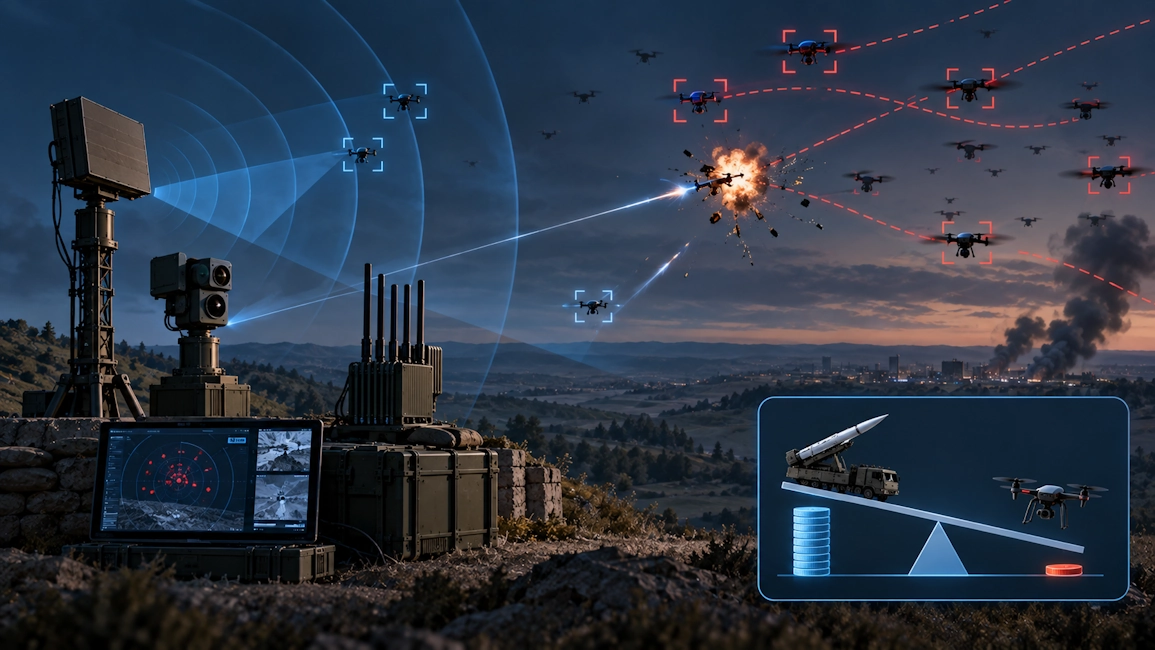
Cheap drones created another fast-growing technology category: systems designed to detect and stop drones.
Counter-UAS platforms combine several technologies:
- radar
- computer vision
- thermal cameras
- RF detection
- acoustic sensors
- sensor fusion
- electronic warfare
- interceptor drones
- directed energy
The interesting part in 2026 is not the sensor list. It is the economics.
Russia launched 8,161 Shahed-type drones in May 2026, the heaviest month recorded, against which Ukraine reported an interception rate above 91 percent. Open-source estimates place Shahed and locally produced Geran unit costs in the $40,000 to $80,000 range. Answering that with Patriot interceptors costing millions each is an unsustainable exchange.
The fix is cost inversion. Kyiv-based MaXon Systems built an autonomous fixed-wing interceptor reportedly costing around $3,500 per unit, and Wild Hornets' STING quadcopter interceptor reportedly costs roughly $2,100. Most interceptors now sit in a 1,000- to 2,500-dollar band.
The scaling is fast. Ukraine's defense ministry said in April 2026 that the military had received twice as many interceptor drones in the first four months of 2026 as in all of 2025, supplied through three parallel channels: direct contracts with the Defense Procurement Agency, the Army of Drones Bonus program, and the DOT-Chain Defense marketplace. In March 2026 alone, interceptor drones downed more than 33,000 Russian UAVs of various types, and the overall interception rate rose to 89.9 percent from 80.2 percent in December.
The interesting software problem lies in combining many imperfect sensors into one reliable picture, and doing it fast enough and cheap enough to matter at that volume.
Ground, Maritime and Space Systems
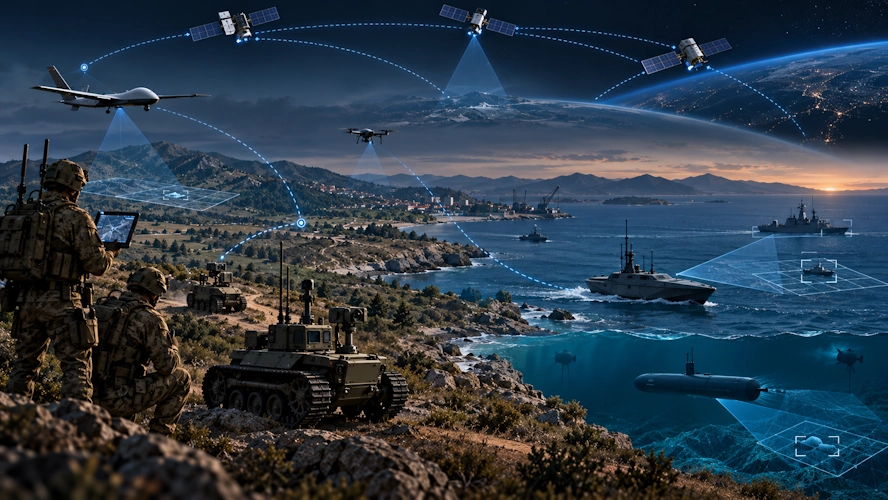
Autonomy extends far beyond flying drones.
Ukraine has rapidly increased the use of UGVs for logistics and evacuation, and the growth curve is steep. Missions recorded in DELTA rose every month through 2026: 7,511 in January, 7,960 in February, 9,072 in March, 11,028 in April, 14,059 in May, 16,664 in June, and 19,969 in July, with another 15,729 between 1 and 20 August. That put the year-to-date total above 100,000 logistics and evacuation missions. Ukraine contracted more than 22,000 ground robotic systems in the same period, almost twice the whole previous year, and the number of units operating them rose from 67 in November 2025 to 167 in March 2026.
The platforms themselves are diversifying. Roboneers has shown UGVs for casualty evacuation over tens of kilometers under FPV threat. SMART BIRDS introduced VORON in August 2026, a UGV carrying net launchers to intercept approaching drones, which is a counter-drone platform on a ground chassis.
Maritime drones have shown the value of relatively inexpensive autonomous platforms compared with much more expensive traditional assets.
Space follows the same software trend. Satellites increasingly perform onboard processing, AI inference, autonomous coordination, and inter-platform communication rather than acting only as remote sensors. NATO's Alliance Persistent Surveillance from Space program has secured over a billion dollars in commitments from 17 member nations across five years and contracts commercial providers such as Planet Labs and ICEYE for optical and radar imagery.
TechStack in MilTech

Embedded and Robotics
AI and Computer Vision
Backend and Data
- Go, Java, C++, Python, and .NET
- PostgreSQL and PostGIS
- time-series databases
- event-driven architecture
- Kafka, NATS, and other messaging technologies
- Kubernetes
- cloud and edge infrastructure
Interoperability and Standards
This layer separates a demo from something a military can actually field. If you only learn one unfamiliar area from this article, make it this one.
- Cursor on Target (CoT) and the TAK ecosystem, including ATAK and WinTAK, for tactical situational awareness
- Link 16 and other tactical datalinks
- STANAG 4586 for UAV control system interfaces
- MAVLink for small UAS, including its signing and security extensions
- ROS 2 and DDS security profiles for robotic systems
- MOSA and its concrete standards families: SOSA, FACE, CMOSS, and OMS/UCI
- A-GRA, the Autonomous Government Reference Architecture, which is why Anduril's Fury was able to fly under both Anduril's Lattice and Shield AI's Hivemind autonomy stacks in the same test program
Simulation and Testing
- Software-in-the-Loop testing
- Hardware-in-the-Loop testing
- Gazebo
- NVIDIA Isaac Sim
- Unreal Engine
- Custom simulation environments
Key Players and Products in MilTech

Anduril
Anduril represents the software-first DefenseTech model. Its Lattice platform connects sensors, autonomous platforms, communications, and third-party systems.
From an engineering perspective, Lattice is interesting because of its local-first architecture, edge processing, sensor fusion, and decentralized communication model. Roughly 90 percent of Anduril's hardware reportedly uses commercially available materials, including commercial jet turbines, which is the opposite of the traditional custom-everything model.
2026 moved the company from challenger to incumbent. In March 2026, the US Army signed a ten-year enterprise agreement consolidating more than 120 existing procurement actions around Lattice for counter-drone command and control, though reported contract ceilings differ significantly across sources. In June 2026, the Air Force ordered its FQ-44A Fury into production alongside General Atomics' competing aircraft, with production running at the Arsenal-1 facility in Ohio. Anduril also took over the Army's mixed-reality headset program from Microsoft and is developing the EagleEye headset family with Meta.
Helsing
Helsing is one of Europe's major new DefenseTech companies. Its portfolio includes AI software, autonomous drones, electronic warfare, underwater systems, and autonomous aircraft. Products span the HX-2 strike drone, the Altra reconnaissance-strike software, the Centaur AI pilot that flew a Saab Gripen E in beyond-visual-range trials in June 2025, the Cirra electronic-warfare AI, the SG-1 Fathom underwater glider, and the CA-1 Europa autonomous combat aircraft.
The manufacturing model is worth attention. Helsing's Resilience Factory in southern Germany runs with an initial capacity above 1,000 HX-2 per month and, according to reporting, is engineered to be dismantled and relocated within 24 hours if a security threat emerges. The company closed a 1.8 billion round at an 18 billion valuation in 2026, the largest private raise in European defense tech, and opened a US factory in West Virginia.
Ukraine has become the environment that both validates and challenges these products. See the AI section above for the 2026 dispute over HX-2 frontline performance.
Shield AI
Shield AI develops Hivemind, a platform-agnostic autonomy stack built around the DDIL problem: operating where GPS is jammed, and communications are severed.
The architecture is interesting because autonomy becomes a software layer instead of functionality tightly coupled to one vehicle. Hivemind has flown modified F-16s in DARPA autonomous dogfighting work and flown Anduril's Fury, a rare public demonstration of genuine autonomy-stack portability.
The company raised a Series G of around $1.5 billion at a $12.7 billion valuation in March 2026 and is projecting more than $540 million in revenue for the year. It unveiled the X-BAT, a VTOL autonomous fighter, in October 2025. Ukraine's Ministry of Defense named Shield AI a verified business partner in August 2025, and Poland has been discussing a servicing center and local production.
Palantir
Palantir focuses on large-scale data integration, analytics, AI, and decision-support platforms.
Its defense work demonstrates another side of MilTech: connecting information from many systems and converting fragmented data into one operational picture. Two details matter for engineers. First, Maven Smart System is built on an open architecture intended to let third-party vendors plug capabilities in, with Palantir explicitly working to get smaller firms through the Authority to Operate process. Second, Palantir Federal Cloud Service holds Impact Level 5 and Impact Level 6 authorizations. Accreditation, not features, is often the moat in this segment.
Lockheed Martin
Lockheed Martin represents the traditional defense industry moving toward software-defined systems, AI, autonomy, open architectures, and multi-domain integration. The primes are not being replaced. They are being forced to open their architectures and to integrate non-traditional suppliers.
Saab
Saab works across radar, aircraft, electronic warfare, autonomous systems, and C5ISR. The company is also increasing investment in battlefield AI and software-centric command platforms, and its Gripen E served as the testbed for Helsing's Centaur AI pilot trials.
Ukraine's DefenseTech Ecosystem
Ukraine is best understood as an ecosystem, not a single company.
Brave1 combines a grant program, a testing network, and a marketplace. By mid-2026, it had issued over 750 grants totaling 3.7 billion UAH. Its public cluster page lists more than 500 UAV manufacturers, more than 200 AI product manufacturers, 50 missile manufacturers, more than 20 naval drone manufacturers, and more than 40 ammunition manufacturers. Brave1 has also launched a fast-track membership track for established manufacturers that do not need grant support, and it runs Defense Tech Valley, held in Lviv on 16 and 17 September 2026 after a 2025 edition that drew more than 5,000 participants and over 100 million dollars in investment.
This scale makes Ukraine one of the most important current environments for rapid DefenseTech development and battlefield validation. It is also, increasingly, an exporter rather than only a recipient.
The Money and Policy Layer

Most technical articles skip this. That is a mistake, because in this industry policy determines which projects exist, which get funded, and which engineers are even eligible to work on them.
NATO
- At the Hague summit in June 2025, allies committed to invest 5 percent of GDP annually by 2035, split into at least 3.5 percent for core defense requirements and up to 1.5 percent for critical infrastructure, network defense, and resilience, with a review clause in 2029.
- The Rapid Adoption Action Plan targets adoption of new technological products within a maximum of 24 months, backed by NATO Innovation Ranges for continuous testing, NATO Innovation Badges as a vetting signal for investors and buyers, Task Force X for integrating mature products into force structures, and a Front Door for Industry.
- A further Innovation Scale-Up Package followed in July 2026, focused on moving from prototypes to mass production, which NATO has publicly identified as its next bottleneck.
- DIANA's 2026 cohort is its largest yet: 150 firms from 24 nations selected from more than 3,000 applicants, each receiving 100,000 euros in Phase 1, with access to 16 accelerator sites and more than 200 test centers across ten challenge areas.
- NATO's broader work on emerging and disruptive technologies is summarised on its innovation and technology adoption page. Officials reported that late-stage investment in defense, security, and resilience had tripled to $ 4.5 billion.
European Union
- The Readiness Roadmap 2030 defines four flagship projects: the European Drone Defense Initiative, Eastern Flank Watch, the European Air Shield, and the European Space Shield.
- The European Drone Defense Initiative (EDDI) is the former "drone wall", renamed to reflect a multi-layered, interoperable counter-drone and precision-strike network rather than a physical barrier. Launch was targeted for Q1 2026, with initial capacity by the end of 2026 and full functionality by the end of 2027. A mature, fully interoperable system is realistically a 2030 target.
- Eastern Flank Watch is co-led by Finland and Poland and runs to the end of 2028, integrating air defense, electronic warfare, surveillance, and maritime security along the eastern border.
- The trigger was concrete. Around twenty suspected Russian drones breached Polish airspace in September 2025, followed by incidents at airports and installations in Germany and Denmark.
- EDDI is intended to draw directly on Ukrainian battlefield experience and to link to a proposed Drone Alliance with Ukraine, with 6 billion euros from interest on immobilized Russian assets earmarked for Ukrainian drone production. Funding for member-state procurement flows partly through the SAFE instrument.
United States
- The FY2026 NDAA was signed on 18 December 2025 and contains a dedicated Acquisition Reform title, establishes portfolio acquisition executives with direct program authority, and stands up Project Spectrum to help small and medium businesses with cybersecurity and acquisition readiness.
- Terminology has shifted. Sources through 2026 refer to the Department of War rather than the Department of Defense; Program Executive Officers have been renamed Capability Program Executives, and Portfolio Acquisition Executives have been introduced. If you read older material, translate accordingly.
- SBIR/STTR was reauthorized through 30 September 2031 in April 2026 after a nearly six-month lapse that froze new solicitations, and the department moved quickly to open new topics.
- Practical entry vehicles for non-traditional suppliers remain OTAs, Commercial Solutions Openings, SBIR, and the Defense Innovation Unit. Andreessen Horowitz maintains a useful practitioner guide to defense contracting for startups.
Ukraine
- DOT-Chain Defense is a defense marketplace where combat units select and order what they need directly using allocated budget funds, while the Defense Procurement Agency handles contracting, payments, and logistics. By May 2026 the military had received 485,000 UAVs and other items worth 31.4 billion UAH through it, with nearly 800 items from more than 200 manufacturers and 218 units connected.
- The system design is worth studying: role-based access, no exact delivery address stored in the system, and a security profile aligned with ISO 27001 and the NIST Cybersecurity Framework.
- An export framework was approved on 1 July 2026. Sales at or above 15 million UAH require export approval, transfers carry no intellectual property rights, and re-export or third-party transfer requires Kyiv's approval.
Features of Development in the MilTech Domain

Degraded Networks
In normal distributed systems, a network partition is an incident.
In MilTech, network partitions are part of the expected environment. DDIL is the design assumption, not the failure case.
Systems need local state, delayed synchronization, graceful degradation, message prioritization, and the ability to operate without central infrastructure.
Hardware Constraints
CPU, GPU, battery capacity, heat, weight, storage, and radio bandwidth directly affect software design.
A model with excellent benchmark results on a data-center GPU provides little value when the target edge computer lacks enough compute or power. Weight budgets on a small airframe are measured in grams, and every gram of compute is a gram of payload or endurance you gave up.
Open Architecture and Interoperability
Military equipment often stays in service for decades while software evolves much faster.
Modern defense programs therefore increasingly favor modular systems, stable interfaces, APIs, reusable components, and open standards.
NATO places strong emphasis on interoperability, while US defense programs use the Modular Open Systems Approach to reduce tight coupling between hardware and software. The concrete standards families are listed earlier in this article, and they are what shows up in requirements documents.
For architects, this creates familiar work around contracts, versioning, adapters, backward compatibility, protocol translation, and integration between old and new systems. The difference is that a breaking change may reach hardware you can't recall.
Compliance and Eligibility Gates
This is the part that surprises engineers coming from commercial software. Compliance is not paperwork bolted on at the end. It determines whether you can bid at all.
- CMMC. The program rule (32 CFR Part 170) took effect in December 2024, and the DFARS clause became enforceable in contracts from November 2025. Phase 2, which would make third-party Level 2 certification the standard, was scheduled for 10 November 2026. On 13 July 2026, the department suspended Phase II third-party certification requirements pending a 60-day reform review, while Phase I self-assessments and the underlying DFARS 252.204-7012 obligations remain fully in effect. If you read a 2025 article stating the November 2026 deadline as settled, verify the current status before you plan around it.
- NIST SP 800-171 remains the control baseline for handling Controlled Unclassified Information regardless of how the certification regime evolves.
- Impact Levels. IL5 and IL6 accreditations, and the Authority to Operate process generally, are often the real barrier to shipping software onto government networks.
- Export control. ITAR and EAR restrict what technical data can cross borders and who can see it. This affects code review, repository access, and where your team can sit.
- Supply chain. The FCC Covered List has been expanded to restrict foreign drones and drone critical components. Component sourcing is now a legal question, not only a cost question.
- Ownership. Foreign Ownership, Control, or Influence rules mean a company's cap table can determine eligibility for classified programs. Startups that structure early can bid on work competitors cannot touch.
Testing and Simulation
Testing autonomous physical systems is expensive.
Simulation therefore plays a much larger role than in ordinary business applications.
Teams use Software-in-the-Loop, Hardware-in-the-Loop, synthetic data, scenario replay, digital twins, and field testing before deploying new versions to physical platforms. NATO's Innovation Ranges and Ukraine's Test in Ukraine program both exist because simulation alone is not enough. The environment contains an adversary who is also iterating.
Rapid Iteration
The Russia-Ukraine war has demonstrated the importance of development speed.
A successful technology quickly produces a countermeasure. Engineers then modify navigation, communications, software, hardware, or operating tactics. The fiber-optic drone story is the cleanest example in this article: jamming won, so one side removed the radio, and the counter is now acoustics and vision.
Defense organizations are trying to institutionalize this. NATO's 24-month adoption target, the US acquisition reform title in the FY2026 NDAA, and Germany's innovation clause in the HX-2 contract are all attempts to make procurement move at software speed.
Autonomy, Ethics and the Human in the Loop
Any honest overview has to address this, because it is a real constraint on system design, not just a debate topic.
The usual distinction is between human-in-the-loop, where a person authorizes each engagement; human-on-the-loop, where the system acts, and a person can intervene; and full autonomy. Most fielded Western systems today are described by their vendors as human-on-the-loop. Helsing describes HX-2 as navigating and tracking autonomously while keeping operators in control of critical decisions.
The governance layer is thinner than the technology layer. NATO has Principles of Responsible Use for AI, and the NATO Innovation Fund has published ethical guidelines aligned with them. The EU AI Act does not apply to systems used exclusively for military purposes, which leaves a gap that member-state law and procurement terms fill unevenly.
For engineers, this shows up as concrete requirements: audit logging of autonomous decisions, replayable decision traces, clear authority boundaries in the C2 layer, positive-identification thresholds, and abort paths that survive a degraded link. If you work on targeting or engagement logic, expect these to be functional requirements with legal weight, not nice-to-haves.
MilTech Trends and Future

Software-Defined Defence
Hardware platforms remain important, but more capability is moving into software.
The same aircraft, drone, sensor, or vehicle receives new functionality through updated autonomy, AI, communication, or mission software. Contracts are starting to reflect this with continuous-upgrade obligations rather than fixed deliverables.
Autonomous Collaboration
The next stage moves from one operator controlling one machine toward one operator supervising multiple autonomous systems.
Swarm and collaborative autonomy technologies are already active research and product areas across Ukraine, NATO, and companies such as Helsing, Anduril, Shield AI, and Swarmer. The Collaborative Combat Aircraft program is the high-end version of the same idea, with the US Air Force targeting at least 150 CCAs by the end of the decade.
Edge AI
More AI inference will move directly onto drones, sensors, vehicles, and satellites.
This reduces latency and dependence on external connectivity while increasing demand for efficient models and specialized hardware.
Mass and Cost Matter Again
Ukraine has demonstrated another major shift: quantity and economics matter alongside technical sophistication.
A 2,000 dollar interceptor that reliably kills a 50,000 dollar attack drone is a better answer than a more capable interceptor you cannot afford to fire. NATO's innovation work reflects the same lesson, combining advanced high-end systems with cheaper technologies designed for rapid production, and NATO has named scaling from prototype to mass production as its next focus area.
The Fiber and RF Split
Expect the drone fleet to keep splitting into wired short-range platforms that ignore jamming and radio-jamming, or autonomous long-range platforms that must survive it. The two branches need different software, different testing, and different countermeasures. Chinese forces are reportedly already incorporating fiber-optic drones, so this is not a Ukraine-specific pattern.
More Counter-Drone Technology
Drone growth drives growth in detection, electronic warfare, interceptor drones, and autonomous defense systems. Europe is now building this at scale through EDDI.
The drone and counter-drone cycle will remain one of the fastest-moving areas in DefenseTech.
How to Get Into MilTech as an Engineer
Three practical notes before you start applying.
Decide dual-use or cleared. Dual-use companies hire more like normal tech companies. Cleared work in the US requires citizenship and a clearance process measured in months. In Europe, the gates are national and vary widely. This single choice narrows your options more than your tech stack does.
Know where the doors are.
- NATO: DIANA challenge calls, NATO Innovation Ranges, and the Front Door for Industry.
- Ukraine: Brave1 grants, the Brave1 Club for established manufacturers, and Test in Ukraine to validate hardware against real feedback.
- United States: SBIR and Direct-to-Phase-II, the Defense Innovation Unit, Commercial Solutions Openings, and OTAs.
- European Union: EDDI and Eastern Flank Watch supply chains, funded partly through SAFE and EDIP.
Match your existing skills to the actual roles. Embedded and robotics engineers go to flight stacks and vehicle control. ML engineers go to edge perception and target re-identification, not large model training. Backend and distributed-systems engineers go to C2, telemetry ingestion, geospatial data, and marketplace or logistics platforms, which is where a .NET, Go, or Java background transfers almost directly. DSP and RF engineers go to EW and communications. There is also persistent demand for simulation engineers and for security and compliance engineers, and the second group is chronically undersupplied.
One honest caveat. Procurement is still slow, most contracts are lumpy, and a large share of defense startups die in the gap between prototype and production. The 2026 reforms target that gap, but they are recent enough that nobody knows yet whether they worked.
Conclusion

MilTech today sits at the intersection of robotics, distributed systems, AI, computer vision, embedded development, cybersecurity, networking, and cloud infrastructure.
The war in Ukraine has become the clearest current example of how quickly these technologies evolve under real operational pressure. NATO, the European Union, the United States, European defense companies, and new DefenseTech startups are adopting many of the same lessons around autonomy, edge computing, interoperability, rapid iteration, and software-defined platforms.
It is worth stating the obvious caveat. This whole picture assumes the current tempo continues. A ceasefire, a budget reversal, or a shift in transatlantic policy would quickly change funding, priorities, and hiring. Treat every number in this article as a snapshot.
For engineers, the technologies often look familiar. The environment changes the engineering problem.
Limited connectivity, electronic interference, hardware constraints, real-time processing, compliance gates, and long-lived physical platforms turn familiar software architecture problems into much harder ones. This is what makes MilTech one of the most technically interesting industries to follow today.