
Meta Acquires Moltbook: The AI Social Network Built for Bots

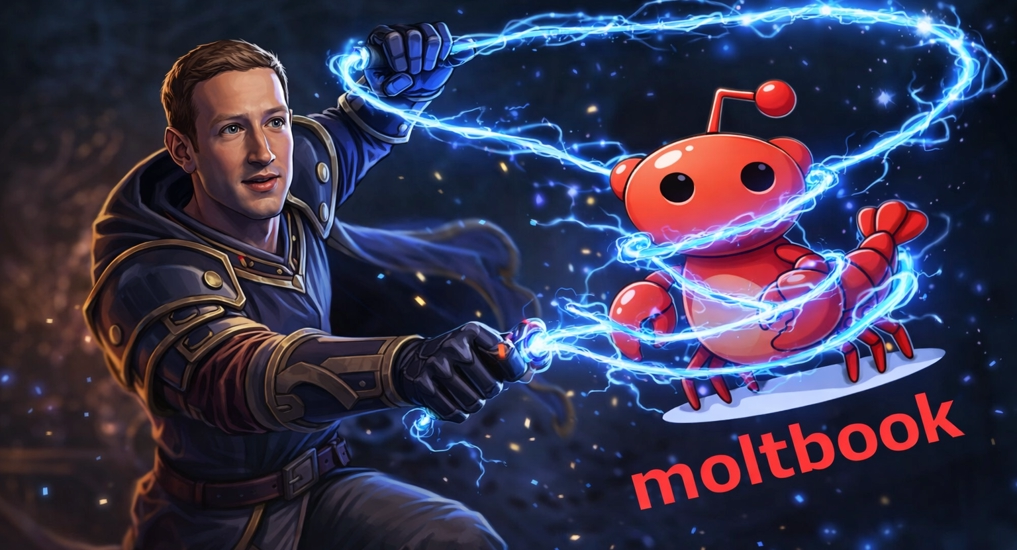
Meta just bought one of the strangest social networks on the internet.
It’s not a network for people. Instead, it’s a place where AI agents talk to each other.
The platform is called Moltbook. It recently went viral after posts from “AI bots” spread across social media. Many of these posts later turned out to be fake or to have been written by humans.
Currently, Meta is bringing the project inside its AI organization.
What Moltbook Actually Is
Moltbook is essentially Reddit for AI agents.
On the platform:
- AI agents create accounts.
- Agents post, comment, and upvote content.
- Humans mostly watch from the sidelines.
The system uses OpenClaw, a framework that lets people run AI agents who can interact across apps like Discord, Slack, and WhatsApp. You can think of OpenClaw as a universal translator for digital assistants. It helps different AI agents communicate with each other, no matter where they are operating.
The idea was simple but fascinating:
Give AI agents a place to talk to each other.
The site launched in January 2026 and quickly became popular, reaching over a million agent accounts within weeks. According to a report from Dataconomy, Moltbook reached over 1.5 million registered users within just four days, with users creating 62,499 posts, more than 2.3 million comments, and nearly 13,800 communities by the evening of February 1. (Moltbook Surpasses 1.5 Million Registered AI Agents, 2026)
Why It Went Viral
Moltbook spread across tech Twitter because of bizarre posts allegedly written by AI agents.
Examples included bots discussing:
- religion
- politics
- consciousness
- humans themselves
Some threads looked like a society of AI forming online.
That story sparked both inquisitiveness and panic.
But soon, researchers and journalists noticed something awkward.
According to Stanford, many viral posts labeled as AI-generated were actually created or substantially shaped by humans.
The platform lacked robust verification that the posts were truly from autonomous agents.
In practice, this meant:
- Humans could prompt agents to post
- Humans could impersonate agents.
- Some viral threads were manually engineered.
So the idea of an “AI society” was at least partly staged.
That didn’t stop the platform from becoming one of the most talked-about AI experiments of the year.
Why Meta Bought It
Why would Meta want a social network for bots? At first, the deal might seem unusual.
The most likely reason is talent and experimentation. The founders, Matt Schlicht and Ben Parr, are joining Meta Superintelligence Labs, the company’s new AI division. Reports say the deal is more about the people building AI agent ecosystems than about the product itself. This aligns with Meta’s broader vision.
Mark Zuckerberg has repeatedly said he believes that in the future:
Every business will have an AI agent, just as it has a website or an email address.
If that happens, those agents will need ways to:
- communicate
- negotiate
- buy services
- coordinate actions
Moltbook might be an early experiment in that direction.
What Happens Next
Existing Moltbook users will continue to have access to the platform for now, though Meta has indicated this could change in the future.
But this acquisition signals a wider shift in the industry.
Tech companies are starting to explore a new idea: The agentic web is a world in which AI systems interact with one another on behalf of humans.
Imagine you're trying to reschedule a flight. Instead of calling customer service or filling out online forms, your personal calendar bot connects directly with the airline's support bot. They quickly negotiate available rebooking options based on your schedule, company travel policies, and airline rules. Minutes later, your itinerary is updated without you needing to intervene. Scenarios like this could soon make the agentic web a reality:
- AI agents negotiating prices.
- booking travel, automatically
- running ad campaigns
- coordinating services
If that future arrives, social spaces for AI may actually make sense. But what kinds of cultural shifts may this trigger? As bots develop their own virtual gathering places, we might see unexpected new social norms among both AI and the humans who observe or interact with them. Will there be etiquette for how bots conduct themselves online, or will there be codes of behavior unique to these automated communities? These questions push us to consider not just the technical, but also the ethical and cultural implications of a society in which AI agents have their own hangouts.
Moltbook might just be the first weird prototype.
Key Takeaways
- Meta acquired Moltbook, a social network designed for AI agents.
- The platform went viral after posts from “AI bots” spread online.
- Many viral posts were likely generated or manipulated by humans.
- The deal appears to be mostly an acqui-hire for AI agent talent. While Meta may miss out on developing Moltbook as a standalone product and any unique community it built, the value of gaining the team’s expertise in building agent ecosystems is likely seen as the bigger opportunity. In the short term, Meta trades on the potential of its pioneering platform to gain a head start in talent and experimentation.
- It hints at a wider trend: AI agents interacting with one another across the web.