
Top 10 Unit Testing Anti-Patterns in .NET and How to Avoid Them
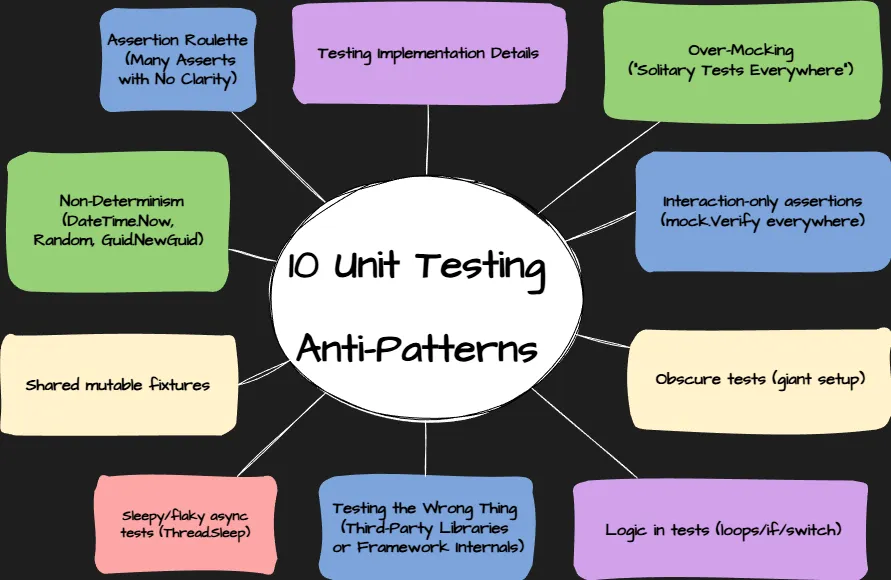
A healthy unit test suite is supposed to be your safety net: fast feedback, reliable results, and the confidence to refactor. But many .NET codebases drift into a place where tests become fragile, slow, and tightly coupled to implementation details.
This article collects the most common unit test anti-patterns (“test smells”) you’ll see in .NET projects and shows practical fixes.
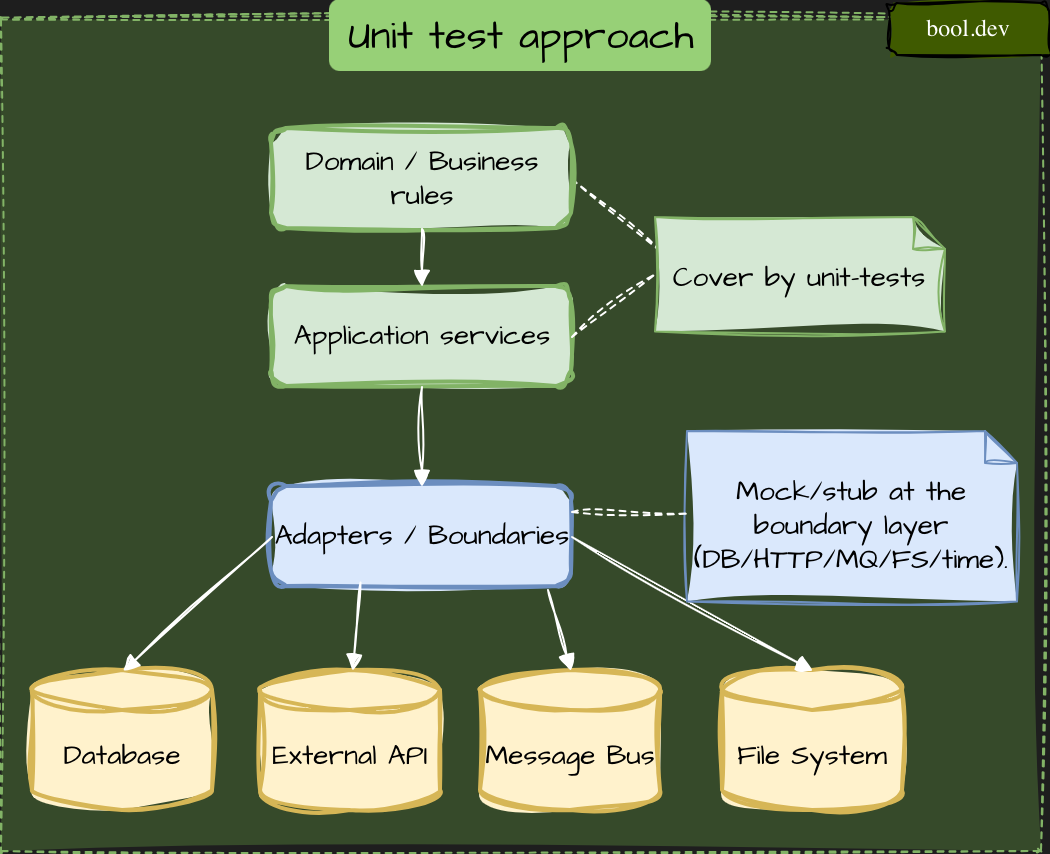
FIrstly lets discuss the project structure and what to cover and what not to cover by unit tests:
Anti-Pattern 1: Testing Implementation Details
Smell
- Reflection to call private methods
InternalsVisibleToadded purely for tests- Asserting “private helper X was called.”
Example:
// ❌ Bad: testing a private method via reflection (brittle, implementation-coupled)
[Fact]
public void CalculateTax_ReturnsExpected()
{
    var order = new Order(/* ... */);

    var method = typeof(Order).GetMethod("CalculateTax",
        BindingFlags.Instance | BindingFlags.NonPublic);

    var tax = (decimal)method!.Invoke(order, null)!;

    Assert.Equal(2.50m, tax);
}
Fix
Test via public API
If private logic is complex, extract it into a separate class with a clear responsibility and test that class through its public surface.
// ✅ Good: test behavior via public API
[Fact]
public void Finalize_AddsTaxToTotal()
{
    var order = new Order(subtotal: 50m, taxRate: 0.05m);

    order.Finalize();

    Assert.Equal(52.50m, order.Total);
}
When private logic is genuinely complex
Extract it into a separate class with a public contract:
public sealed class TaxCalculator
{
    public decimal Calculate(decimal subtotal, decimal rate) => subtotal * rate;
}
Anti-Pattern 2: Over-Mocking (“Solitary Tests Everywhere”)
Smell
A test mocks every dependency, even simple domain objects and internal helpers, so the test setup mirrors the internal code structure. It's also called a solitary unit test
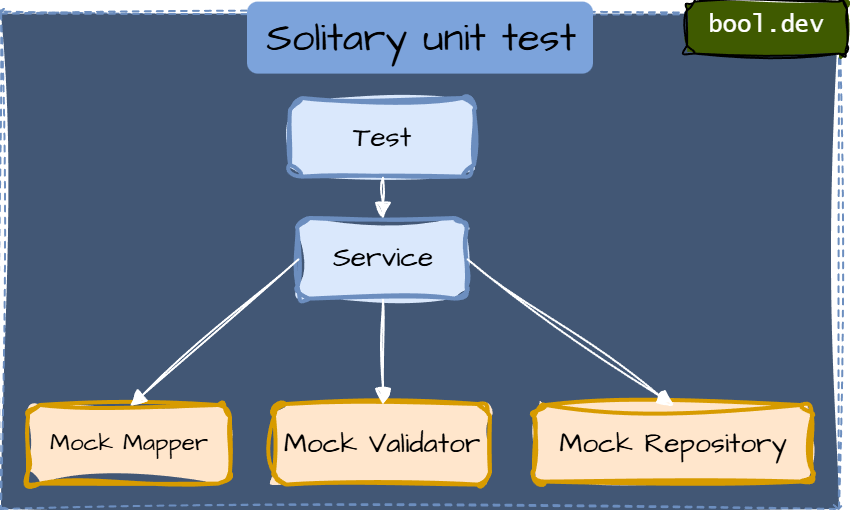
Example (bad): mocking internal helpers
// ❌ Bad: mocking mapper + validator (internal structure leaks into test)
[Fact]
public async Task CreateUser_CallsMapper_ThenSaves()
{
    var mapper = new Mock<IUserMapper>();
    var validator = new Mock<IUserValidator>();
    var repo = new Mock<IUserRepository>();

    mapper.Setup(m => m.Map(It.IsAny<CreateUserRequest>()))
          .Returns(new User("alice"));

    validator.Setup(v => v.Validate(It.IsAny<User>())).Returns(true);

    var sut = new UserService(mapper.Object, validator.Object, repo.Object);

    await sut.CreateUser(new CreateUserRequest("alice"));

    mapper.Verify(m => m.Map(It.IsAny<CreateUserRequest>()), Times.Once);
    validator.Verify(v => v.Validate(It.IsAny<User>()), Times.Once);
    repo.Verify(r => r.Save(It.IsAny<User>()), Times.Once);
}
Fix: Prefer “Sociable” Unit Tests
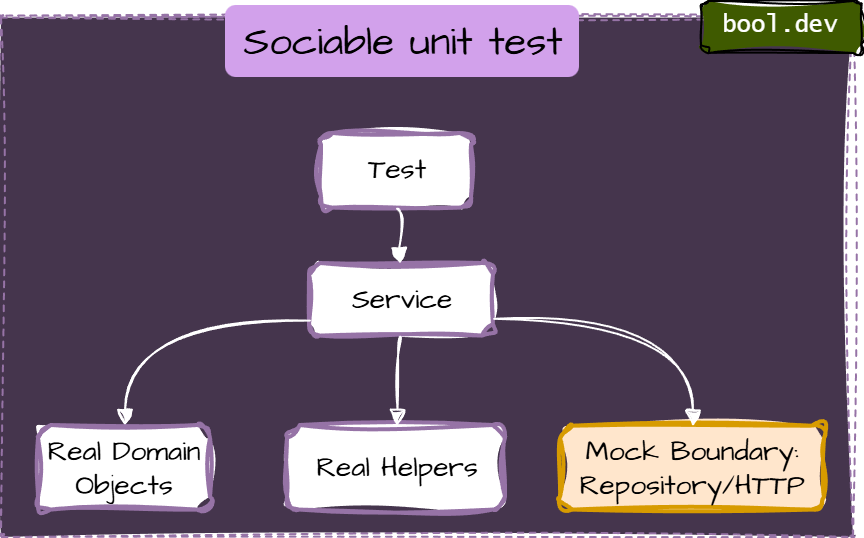
- Use real implementations for internal collaborators (domain models, value objects, simple calculators). Mock only true boundaries:
- database repositories (if you’re unit-testing application logic)
- external HTTP APIs
- message buses
- filesystem
- clock/time and randomness
// ✅ Better: real mapper/validator (internal), mock only repository (boundary)
[Fact]
public async Task CreateUser_PersistsValidUser()
{
    var repo = new Mock<IUserRepository>();
    var sut = new UserService(
        mapper: new UserMapper(),
        validator: new UserValidator(),
        repo: repo.Object);

    await sut.CreateUser(new CreateUserRequest("alice"));

    repo.Verify(r => r.Save(It.Is<User>(u => u.Name == "alice")), Times.Once);
}
Even better: if your service returns a result, assert that too:
[Fact]
public async Task CreateUser_ReturnsCreatedUserId()
{
    var repo = new InMemoryUserRepository(); // fake boundary, still deterministic
    var sut = new UserService(new UserMapper(), new UserValidator(), repo);

    var id = await sut.CreateUser(new CreateUserRequest("alice"));

    Assert.True(repo.Exists(id));
}
Anti-Pattern 3: Interaction-only assertions (mock.Verify everywhere)
Smell
Interaction assertions are sometimes useful at boundaries (“did we call the HTTP client?”), but they become brittle when used to verify internal steps.
Example: verifying “how”
// ❌ Brittle: couples test to internal persistence strategy
repo.Verify(r => r.Save(order), Times.Once);
repo.Verify(r => r.Flush(), Times.Once);
Fix: assert outcome/state
If you’re unit testing domain/application logic, assert state:
[Fact]
public void Finalize_SetsStatusToFinalized()
{
    var order = new Order(subtotal: 100m, taxRate: 0.1m);

    order.Finalize();

    Assert.Equal(OrderStatus.Finalized, order.Status);
}
Anti-Pattern 4: Obscure tests (giant setup)
Smell
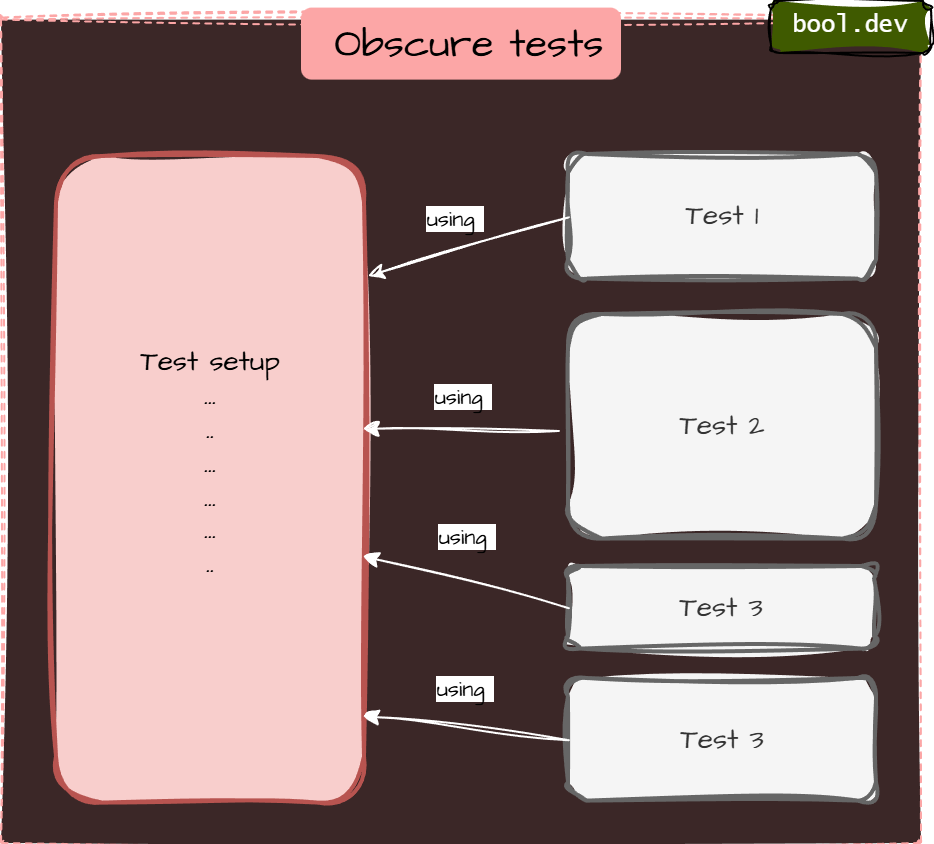
- 100+ lines of setup
- The important inputs are buried
- copying setup across tests
Fix: AAA + Test Data Builder
public sealed class OrderBuilder
{
    private decimal _subtotal = 100m;
    private decimal _taxRate = 0.1m;

    public OrderBuilder WithSubtotal(decimal value) { _subtotal = value; return this; }
    public OrderBuilder WithTaxRate(decimal value) { _taxRate = value; return this; }

    public Order Build() => new Order(_subtotal, _taxRate);
}
Test becomes readable:
[Fact]
public void Finalize_ComputesTotal()
{
    var order = new OrderBuilder()
        .WithSubtotal(50m)
        .WithTaxRate(0.05m)
        .Build();

    order.Finalize();

    Assert.Equal(52.50m, order.Total);
}
Anti-Pattern 5: Logic in tests (loops/if/switch)
Smell
Tests contain branching logic. Now you’ve written code inside your test that also needs testing
Example (bad)
[Fact]
public void DiscountRules_Work()
{
    foreach (var subtotal in new[] { 99m, 100m, 150m })
    {
        var order = new Order(subtotal, taxRate: 0m);
        order.ApplyDiscounts();

        if (subtotal >= 100m)
            Assert.True(order.HasDiscount);
        else
            Assert.False(order.HasDiscount);
    }
}
Fix: parameterized tests
- Keep tests linear and explicit.
- Use parameterized tests instead of loops:
- xUnit:
[Theory]+[InlineData] - NUnit:
[TestCase]
- xUnit:
Example (xUnit)
[Theory]
[InlineData( 99, false)]
[InlineData(100, true)]
[InlineData(150, true)]
public void ApplyDiscounts_SetsHasDiscount_WhenThresholdMet(decimal subtotal, bool expected)
{
    var order = new Order(subtotal, taxRate: 0m);

    order.ApplyDiscounts();

    Assert.Equal(expected, order.HasDiscount);
}
Anti-Pattern 6: Sleepy/flaky async tests (Thread.Sleep)
Smell
Using fixed delays to “wait for work”.
Example (bad)
[Fact]
public async Task SendsEmailEventually()
{
    var sut = new EmailDispatcher();

    sut.Dispatch("a@b.com", "hi");
    Thread.Sleep(1000); // ❌ flaky + slow

    Assert.True(sut.WasSent);
}
Fix A: await the work (best)
If the API can expose a Task, do it:
[Fact]
public async Task SendsEmail()
{
    var sut = new EmailDispatcher();

    await sut.DispatchAsync("a@b.com", "hi");

    Assert.True(sut.WasSent);
}
Fix B: poll with timeout (when you can’t await directly)
private static async Task Eventually(Func<bool> condition, TimeSpan timeout)
{
    var start = DateTime.UtcNow;
    while (DateTime.UtcNow - start < timeout)
    {
        if (condition()) return;
        await Task.Delay(20);
    }
    throw new TimeoutException("Condition was not met within the timeout.");
}

[Fact]
public async Task SendsEmail_Eventually()
{
    var sut = new EmailDispatcher();

    sut.Dispatch("a@b.com", "hi");

    await Eventually(() => sut.WasSent, TimeSpan.FromSeconds(2));
}
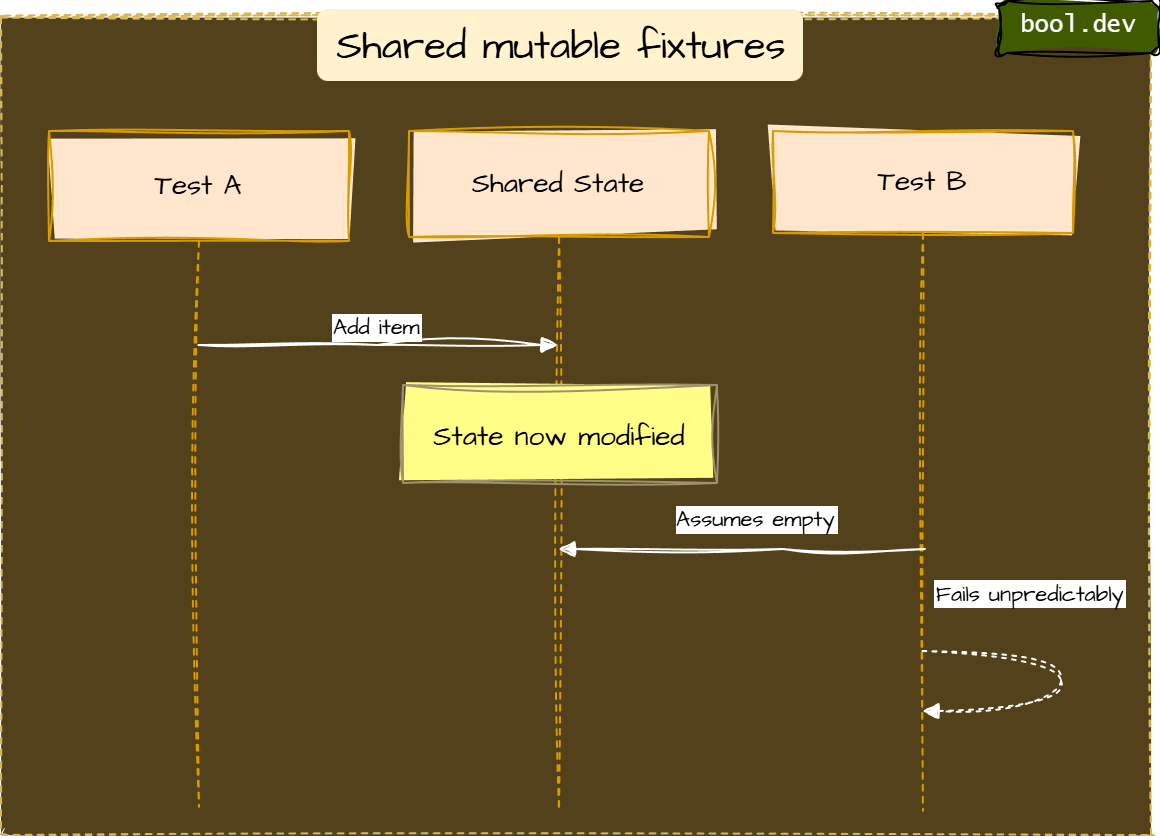
Anti-pattern 7: Shared mutable fixtures
Smell
Static/shared state reused across tests:
- shared in-memory list
- shared DB without reset
- singleton services holding state
Fix
- Make each test independent (fresh instances per test)
- Avoid static mutable state
- If a DB is unavoidable, isolate:
- create schema per test run/class
- Run tests in a transaction and roll back
- Use containerized ephemeral DB in CI (integration layer)
Anti-Pattern 8: Non-Determinism (DateTime.Now, Random, Guid.NewGuid)
Smell
Tests depend on:
- current time
- time zones/culture
- randomness
- machine-specific settings
Example
[Fact]
public void ExpiresInOneHour()
{
    var token = Token.Issue(); // uses DateTime.Now internally
    Assert.Equal(DateTime.Now.AddHours(1), token.ExpiresAt); // ❌ flaky
}
Fix: inject a TimeProvider (.NET 8+)
public sealed class TokenService(TimeProvider timeProvider)
{
    private readonly TimeProvider _timeProvider = timeProvider;

    public Token Issue()
    {
        var now = _timeProvider.GetUtcNow();
        return new Token(expiresAt: now.AddHours(1));
    }
}

public sealed record Token(DateTimeOffset ExpiresAt);
Register it:
builder.Services.AddSingleton(TimeProvider.System);
builder.Services.AddTransient<TokenService>();
for testing use FakeTimeProvider from Microsoft.Extensions.TimeProvider.Testing nuget package
using Microsoft.Extensions.TimeProvider.Testing;
using Xunit;

public class TokenServiceTests
{
    [Fact]
    public void ExpiresInOneHour()
    {
        var fakeTime = new FakeTimeProvider();
        fakeTime.SetUtcNow(new DateTimeOffset(2025, 01, 01, 10, 00, 00, TimeSpan.Zero));

        var sut = new TokenService(fakeTime);

        var token = sut.Issue();

        Assert.Equal(fakeTime.GetUtcNow().AddHours(1), token.ExpiresAt);
    }
}
Anti-Pattern 9: Assertion Roulette (Many Asserts with No Clarity)
Smell
A single test contains a long list of assertions, and when it fails, you don’t immediately know which behavior broke.
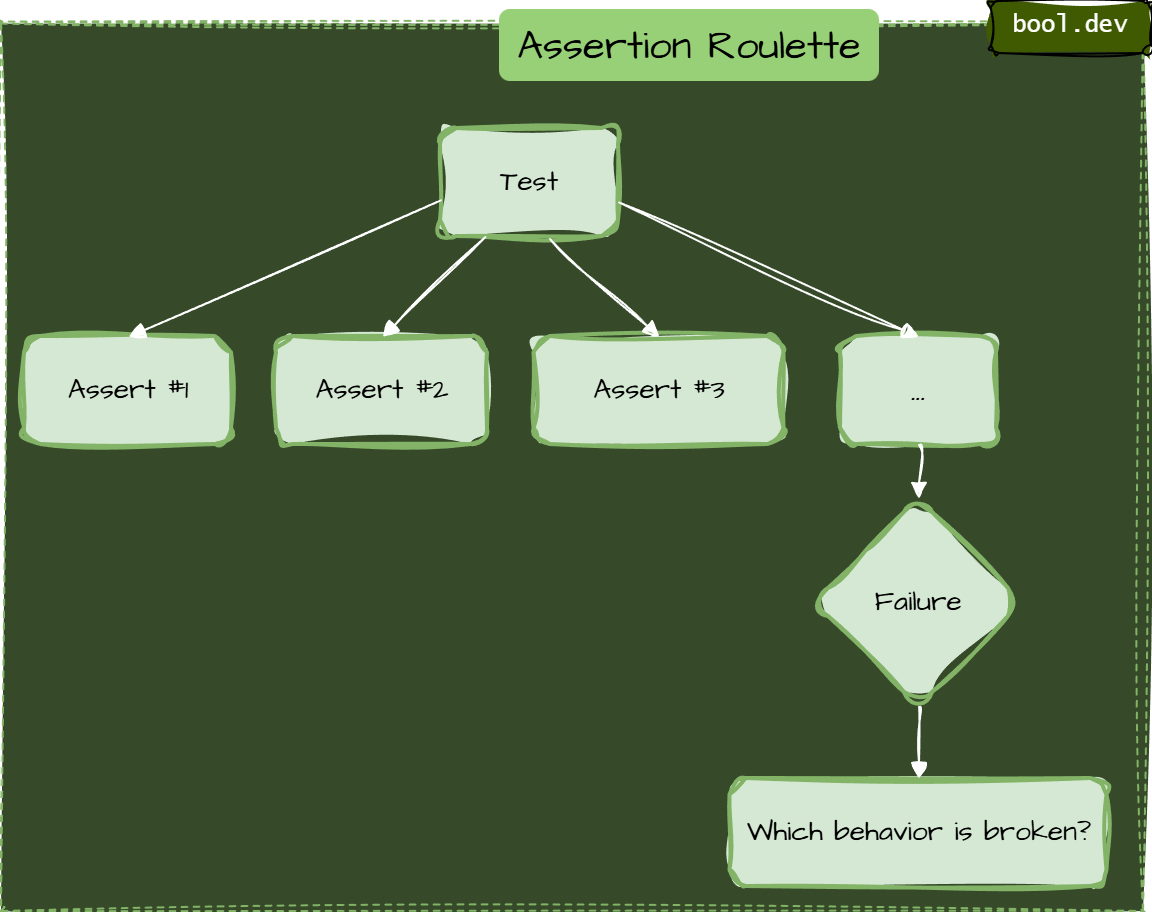
Typical causes:
- testing multiple behaviors at once
- using plain
Assert.True(...)repeatedly without clear intent - validating an entire object graph in one go
Bad: “kitchen sink” test
[Fact]
public void CreateUser_SetsEverythingCorrectly()
{
    var user = User.Create("alice@example.com", "Alice");

    user.Email.Should().Be("alice@example.com");
    user.Name.Should().Be("Alice");
    user.IsActive.Should().BeTrue();
    user.CreatedAt.Should().BeAfter(DateTime.UtcNow.AddMinutes(-1));
    user.Roles.Should().Contain("User");
    user.AuditTrail.Should().NotBeNull();
    user.AuditTrail!.Events.Should().NotBeEmpty();
    user.Profile.Should().NotBeNull();
    user.Profile!.DisplayName.Should().Be("Alice");
    user.Profile!.Locale.Should().Be("en-US");
}
Even if this test is “correct”, it’s hard to diagnose and tends to become brittle as the model evolves.
Fix A: Split by behavior
Write one test per meaningful rule:
[Fact]
public void CreateUser_SetsEmailAndName()
{
    var user = User.Create("alice@example.com", "Alice");

    user.Email.Should().Be("alice@example.com");
    user.Name.Should().Be("Alice");
}

[Fact]
public void CreateUser_IsActiveByDefault()
{
    var user = User.Create("alice@example.com", "Alice");

    user.IsActive.Should().BeTrue();
}

[Fact]
public void CreateUser_AddsDefaultUserRole()
{
    var user = User.Create("alice@example.com", "Alice");

    user.Roles.Should().Contain("User");
}
Fix B: Use “assertion scopes” to improve failure signal
If you do need multiple asserts (e.g., for a single cohesive behavior), make failures easier to read. FluentAssertions has AssertionScope:
using FluentAssertions.Execution;

[Fact]
public void CreateUser_InitializesDefaults()
{
    var user = User.Create("alice@example.com", "Alice");

    using (new AssertionScope())
    {
        user.IsActive.Should().BeTrue();
        user.Roles.Should().Contain("User");
        user.Profile.Should().NotBeNull();
    }
}
Fix C: Prefer equivalence with explicit intent
Sometimes a concise “shape check” is best:
[Fact]
public void CreateUser_InitializesUser()
{
    var user = User.Create("alice@example.com", "Alice");

    user.Should().BeEquivalentTo(new
    {
        Email = "alice@example.com",
        Name = "Alice",
        IsActive = true
    }, options => options.ExcludingMissingMembers());
}
Anti-Pattern 10: Testing the Wrong Thing (Third-Party Libraries or Framework Internals)
Smell
You write unit tests that prove ASP.NET Core, EF Core, Newtonsoft/System.Text.Json, or AutoMapper behave as documented — without asserting your business rule or configuration intent.
This is common when tests are created to “increase coverage” rather than to protect behavior.
Bad example: testing JSON library behavior
[Fact]
public void SystemTextJson_SerializesCamelCase()
{
    var json = JsonSerializer.Serialize(new { FirstName = "Alice" },
        new JsonSerializerOptions { PropertyNamingPolicy = JsonNamingPolicy.CamelCase });

    json.Should().Be("{\"firstName\":\"Alice\"}"); // ❌ testing the library
}
Better: test your contract or mapping configuration (integration-ish)
If your API contract requires camelCase, test your endpoint (or your serialization settings) in a minimal integration test.
Example: ASP.NET Core minimal integration test using WebApplicationFactory (conceptual):
[Fact]
public async Task GetUser_ReturnsCamelCasedJsonContract()
{
    // Arrange: boot app with real JSON settings
    using var app = new WebApplicationFactory<Program>();
    var client = app.CreateClient();

    // Act
    var response = await client.GetStringAsync("/users/1");

    // Assert: verify contract you own (keys you promise)
    response.Should().Contain("\"firstName\"");
}
This doesn’t “test System.Text.Json”; it tests your published API contract.
Bad: testing EF Core internal behavior as a unit test
[Fact]
public void EfCore_TracksEntities()
{
    using var db = new AppDbContext(/* ... */);
    var user = new User("alice@example.com");

    db.Users.Add(user);

    db.ChangeTracker.Entries().Should().HaveCount(1); // ❌ EF internal behavior
}
Better: test your persistence mapping as an integration test
If you care that a User is persisted and can be loaded correctly, test that:
[Fact]
public async Task User_CanBePersistedAndLoaded()
{
    // Use test database (or container) in integration tests
    await using var db = TestDb.CreateContext();

    var user = new User("alice@example.com");
    db.Users.Add(user);
    await db.SaveChangesAsync();

    var loaded = await db.Users.SingleAsync(u => u.Email == "alice@example.com");

    loaded.Email.Should().Be("alice@example.com");
}
This test protects your mapping + constraints + configuration, which is the part you actually own.
Summary
Unit tests are only valuable when they make change safer. If your suite punishes refactoring, it’s not a “strict” suite — it’s a tightly coupled one.
When you review your tests, aim for these outcomes:
- Test observable behavior through the public API.
- Mock only true boundaries (DB/HTTP/MQ/filesystem/time), not internal helpers.
- Prefer state/outcome assertions over interaction choreography.
- Keep tests small, readable, and deterministic (no sleeps, no shared mutable state, no hidden randomness/time).
- Avoid assertion roulette by writing one test per rule (or intentionally using scopes).
- Don’t unit-test third-party libraries; use targeted integration tests to validate your wiring and contracts.
A practical litmus test to keep in mind:
If I can rewrite the internals completely and keep behavior the same, my tests should stay green.
That’s what a maintainable test suite looks like: it protects what matters, stays out of your way, and earns your trust every day.
Tags:
Comments: